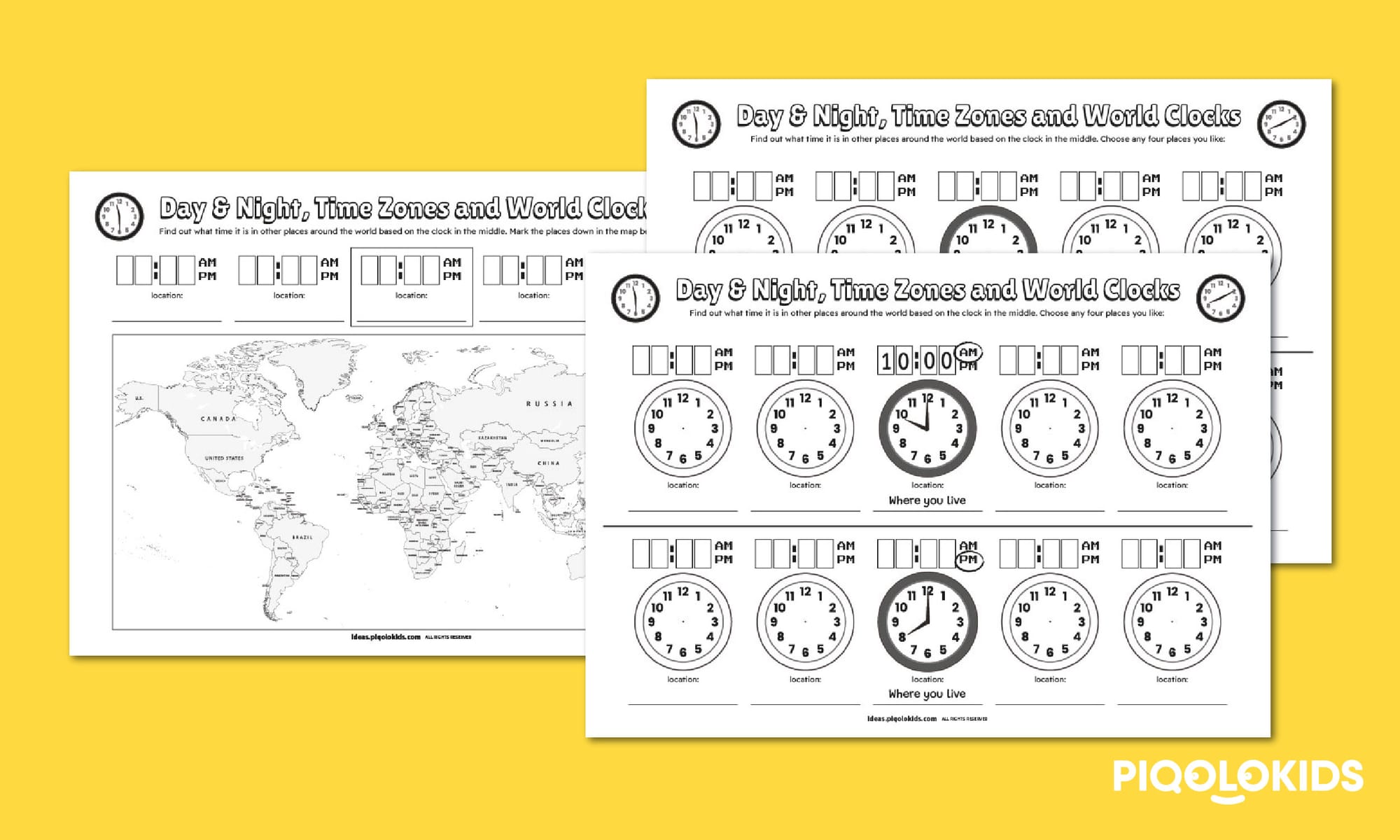
Esteemed educators! I'm thrilled to take your students on an exciting journey through the intricacies of our planet's timekeeping. This printable activity is designed to provide an introductory understanding of the captivating concepts of day and night, time zones, and the fascinating world of world clocks.
During this activity, you students will learn about the rotation of the Earth and how it affects the occurrence of day and night. By the end of this activity, you'll have a better appreciation of the wonders of our planet's timekeeping, which will help you to better educate your students on this essential topic. So get ready to embark on a fascinating journey through the world of timekeeping that will leave you enlightened and inspired!
Let's get started!
Printable & Activity Objectives
💡
Age: 8 to 9 year olds, Activity Time: 2-3 hours, Items Needed: Writing pencils
Designed for elementary students, this activity aims to foster a deeper understanding of how time is measured and experienced across different regions of our globe.
It will help your child or student with:
Geographical Understanding: Students will learn about the Earth's rotation, its effect on day and night, and how time zones are established based on longitudinal and geographical divisions.
Mathematical Skills: Practical applications related to timekeeping can help students improve their mathematical skills by using concepts such as addition and subtraction of hours when calculating time differences across time zones.
Global Perspective: Engaging with world clocks and time zones promotes a global perspective among students. They learn about the interconnectedness of nations and the importance of coordination across different time zones for activities such as international communication, trade, and travel.
Technology Literacy: When exploring world clocks, students can use digital tools like online time zone converters and interactive maps to enhance their technology literacy and proficiency in navigating educational digital platforms.
Let's get started!
Classroom Resources
Simple steps to start:
Research and learn more about the science behind time zones and how to calculate different time zones around the world. Here's a simple video about why we have day and night:
Take a look at the different online tools that help us visualise day and night in different parts of the world. Here is a simple tool i.e. a live map of where it is daytime, twilight or night time: